
Otero County Court Records After Arrest
After a local arrest in Otero County, the first public trace may be a custody or booking record at the Otero County Detention Center. The court record is a different file. The typical path is arrest, booking, first appearance, prosecutor charging review, then an open court case if charges are filed. The Twelfth Judicial District covers Otero County and Lincoln County, so felony case activity, district court filings, and many post-arrest court records route through that district court system. Magistrate court also matters, because misdemeanors, DWI, traffic cases, and felony preliminary hearings can appear there first.
The booking side can answer whether a person is currently held, when the person was admitted, and whether a bond or hold may affect release. The court side answers a different question: what formal charges did the prosecutor file, what court has the case, and what happened to each count. For custody and jail status, use Otero County jail inmate records. For booking photos, use Otero County jail mugshots. Court records after a jail arrest should be checked through the court portals, the docket page, court IPRA, and the Twelfth Judicial District Attorney when the question involves filed charges.
The Twelfth Judicial District public records page is the main official doorway for court records. It links New Mexico Courts IPRA, New Mexico Caselookup, and re:SearchNM. The same district publishes the Otero County Magistrate Court docket, which shows hearings for the current day and six future days.
Find Otero County Court Records
Start with the court system rather than a jail-only search when the goal is filed charges. Caselookup is the public case search path for current electronic records from New Mexico courts. re:SearchNM is the Tyler/Odyssey portal the Twelfth Judicial District describes as providing case information and documents for registered users. For a near-term hearing, the Otero County Magistrate Court docket can show whether a first appearance, preliminary hearing, or other event is scheduled. If the case is older, missing from the portal, sealed in part, or document-level access is needed, use New Mexico Courts IPRA instead of guessing from a search result.
- Open the Twelfth Judicial District public-records page and choose Caselookup for the public case index.
- Search by the defendant's name or by a known case number when the portal allows that field.
- Check the court name, case type, filing date, party names, and charge list before relying on the result.
- Use re:SearchNM when document access or registered-user Odyssey access is needed.
- Check the Otero County Magistrate Court docket for hearings listed for the current day and the next six days.
The court portal field table is limited because the official sites are dynamic, but the practical search values are clear: party name, case number, court, docket date, and document access status.
| Portal or Channel | Fields or Access | Use After Arrest |
|---|---|---|
| Caselookup | Dynamic public case fields, commonly party or case criteria | Find current electronic court records from New Mexico courts. |
| re:SearchNM | Tyler/Odyssey case information and documents for registered users | Review case documents when access is available through the registered portal. |
| Otero Magistrate docket | Published hearing list, not a search form | Confirm near-term hearings for the current day plus six future days. |
| Court IPRA | Written request for court records | Ask for copies or older files not available through the online index. |
Otero County Arrest Charging Records
A booking charge is an initial law-enforcement allegation. It may come from the arresting officer, a warrant, or a jail intake record. The filed charge is the charge placed before the court after prosecutorial review. The Twelfth Judicial District Attorney's Office serves Otero and Lincoln Counties and decides whether to file, amend, reduce, dismiss, or pursue counts within its jurisdiction. That decision is why a jail booking entry and the later court record may not match word for word.
| Document | Who Files It | Common Use | What To Check |
|---|---|---|---|
| Complaint | Officer or prosecutor | Often starts a magistrate-level case or initial criminal case | Charge name, statute, sworn facts, and first court setting. |
| Information | Prosecutor | Formal district court charging document in many felony matters | Counts filed by the DA, amendments, and arraignment setting. |
| Indictment | Grand jury | Formal charge returned by a grand jury | Count list, date returned, court assignment, and warrant or summons status. |
The first appearance addresses release conditions, custody status, and next settings. It does not prove guilt. Otero County court records after a jail arrest should be read as a case timeline, not as one static arrest label.
Otero County Charge Status Records
Charge status is the part of the court record that shows where each count stands. A person can have several counts in one case, and each count can move in a different way. One charge may stay pending, one may be amended, and another may be dismissed. That is why the case page should be read count by count. The same rule applies when a warrant arrest is involved. A warrant may explain why the person was booked, while the court file explains what charges or missed-court events are active.
| Status | Meaning In Court | Record Caution |
|---|---|---|
| Pending | The count is still active and has not reached final disposition. | Do not treat it as a conviction. |
| Amended or reduced | The prosecutor changed the count or lowered the charge level. | Compare the amended charge to the booking allegation. |
| Dismissed | The court record shows the count was ended without conviction. | Other counts in the same case may still remain active. |
| Nolle prosequi | The prosecutor declined to proceed on that count. | Check whether the dismissal is with or without later refiling limits. |
Otero County Bond After Arrest
Bond connects the jail record to the court record. Otero County's official Bail page says local court bonds for municipal, magistrate, and district cases are posted at the proper court during business hours. Magistrate Court accepts bonds Monday through Friday from 8:00 a.m. to 2:30 p.m. District Court accepts bonds from 8:00 a.m. to 2:30 p.m., excluding holidays. If an eligible bond needs to be posted after business hours, it may be posted at the Otero County Detention Center, but the jail accepts cash only and does not make change.
| Bond Issue | Otero County Rule | Why It Matters |
|---|---|---|
| Business-hour court bond | Post at the correct court. | The courthouse, jail, and sheriff office are separate places. |
| After-hours jail bond | Eligible bonds may be posted at the Detention Center, cash only. | Bring exact cash because the jail does not make change. |
| Municipal ADPS charge | The Detention Center does not write these bonds. | Use Alamogordo DPS after hours. |
| Property or surety bond | Property bonds may go through the Sheriff's Office; court-approved bondsmen may post surety bonds. | The jail does not recommend an agent. |
| Hold or detainer | Another warrant, agency, parole matter, federal hold, ICE hold, fine, or no-bond order may block release. | Payment may not end custody. |
Otero County Warrant Records
No official active-warrant search or public warrant list was located on the current Otero County website. Sheriff David Black's office has a main Sheriff's Office page, but the research did not locate a county warrant database in the site navigation or sitemap. That limit matters for court records after arrest. A person booked on a warrant may appear at the Otero County Detention Center, but the safest official path is to check the issuing court case, call the appropriate court, or use records requests from the agency that issued or served the warrant.
Note: A search warrant authorizes a search. It is not the same thing as an arrest warrant or bench warrant.
Otero County Charges vs Convictions
An arrest and a charge are accusations. A conviction is a result after a guilty plea, verdict, or other final court disposition. A pending count can affect bond, release rules, and future hearings, but it is not a conviction. A dismissed count may remain visible unless sealed, expunged, or restricted by law.
| Point of Comparison | Charge | Conviction |
|---|---|---|
| Stage | Accusation filed by complaint, information, or indictment | Final result after plea, verdict, or judgment |
| Proof level | Based on probable cause or charging review | Requires proof beyond a reasonable doubt or a valid plea |
| Where it appears | Booking, docket, complaint, information, indictment, or case summary | Judgment, sentence, disposition, or final order |
| How to read it | Check status before drawing conclusions | Check sentence, appeal status, and later relief |
Sealed and Expunged Court Records
New Mexico public access starts with IPRA. NMSA 14-2-1 gives every person the right to inspect public records unless an exception applies. NMSA 14-2-1.2 says law-enforcement records are public records, but it also allows redaction or digital obscuring of protected victim, witness, and nonpublic information. Those rules affect booking sheets, incident records, and some arrest-related material. Court files may also be restricted by juvenile confidentiality, sealing orders, expungement orders, or active-investigation concerns.
Expungement is a court process, not a website takedown. The New Mexico DPS expungement page cites the Criminal Records Expungement Act. NMSA 29-3A-5 addresses expungement of records upon conviction for qualifying people when statutory findings are met.
| Record Treatment | Sealed | Expunged |
|---|---|---|
| Public visibility | Hidden from routine public access by court order or rule | Removed or treated as not publicly existing as allowed by the order |
| Agency handling | May still be accessible to certain courts or agencies | Agencies follow the expungement order and statute |
| How it starts | Usually through a court order or confidentiality rule | Through a petition and court order under the Criminal Records Expungement Act |
| What to request | Ask the court clerk what public access remains | Provide the expungement order to affected agencies when needed |
Otero County DA Contact
The prosecutor contact for local felony and qualifying misdemeanor cases is the Twelfth Judicial District Attorney's Office. The DA is not the jail roster office and does not replace court lookup. It is relevant for prosecutor-filed charges, victim services, DA IPRA, and the difference between an arrest allegation and a charge the state chose to file.
Twelfth Judicial District Attorney, Otero County Office
Otero County Courthouse, Room 101
1000 New York Ave., Alamogordo, NM 88310-6998
Phone: (575) 437-3640
Fax: (575) 434-2507
IPRA email: 12thDistrictDAIPRA@da.state.nm.us
Official contact page: Twelfth DA Contact Us
The Twelfth District Attorney contact page lists the Otero County main office and IPRA email.
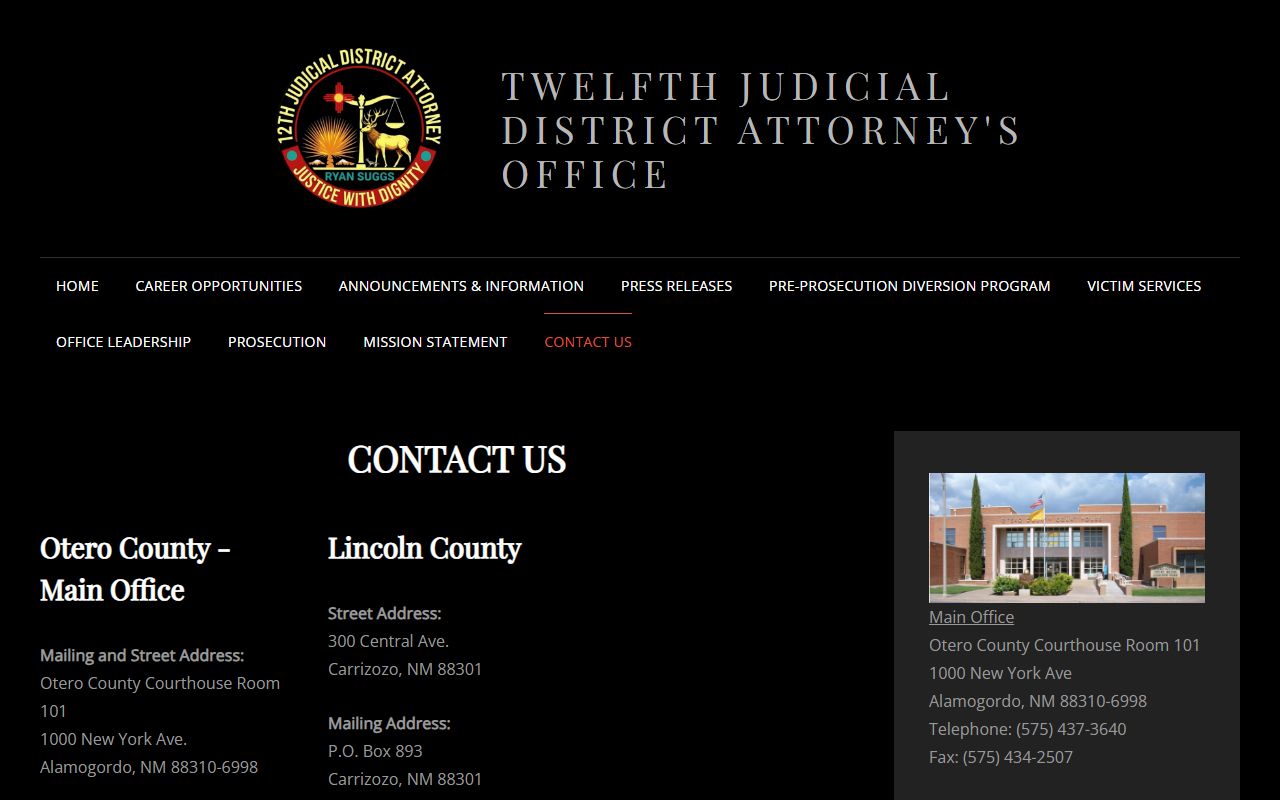
Use that office for prosecutor records, not for jail visitation, after-hours bond, or custody confirmation.
Restricted Otero County Court Records
Not every record tied to an arrest is open in full. Juvenile matters, sealed charges, expunged records, confined-person medical details, protected victim and witness information, and active-investigation material may be withheld or redacted. Otero County's public records request page says the county must permit inspection as soon as practicable and no later than fifteen calendar days after receipt, unless a lawful reason supports denial or delay.
County IPRA is for county-held booking, sheriff, and detention records. Court IPRA is for New Mexico Courts records. DA IPRA is for prosecutor records. A request should identify the person, arrest date, agency, case number if known, and exact record sought.
Important: Public case lookup is not a consumer report and should not be used for employment, tenant, credit, or insurance screening.